
The Research Behind Greatness
Spotting Potential in Others
Most leaders are trained to measure performance. The rarer, more valuable skill is recognizing potential — seeing what the rest of us miss, and knowing who to promote, back, and bet on.
Watch
Spotting potential in action
A closer look at how leaders recognize the patterns that predict potential — and who to promote, back, and bet on.
The Problem
We’re trained to see performance. We miss potential.
At the height of World War II, the most glamorous woman in Hollywood walked into a room full of Navy brass — not to perform, but with a breakthrough that could stop the enemy from jamming Allied torpedoes. The room saw a pretty face and sent her away: “Why don’t you use it to sell war bonds instead?”
Her name was Hedy Lamarr. The “frequency hopping” they waved off became the backbone of WiFi, GPS, and Bluetooth. They were looking right at her. They just couldn’t see her.
We’ve been taught to look for greatness in the obvious — fancy degrees, impressive résumés, big titles, familiar faces. We tell ourselves we’ll know it when we see it. But if you’ll know it when you see it, you’ve already seen it before — and if you only back what you’ve seen before, you stay constrained to where you’ve been.
For two decades I led executive searches, interviewing thousands of candidates for some of the most consequential roles in the country. What I learned is that greatness rarely looks like what we expect. The real question isn’t how to go find it. It’s how to see it in the people already on your team — and how many Hedy Lamarrs are sitting in your organization right now, waiting to be seen.
“Most leaders are trained to spot performance. I study the patterns that predict potential.”
The Big Idea
Spotting potential is intuition — and intuition can be taught.
We celebrate leaders with “great instincts,” but rarely examine how those instincts form, or how they fail. My doctoral research, The Role of Intuition in the Hiring Process, treats intuition not as a magic trick but as a sensemaking process — one that can be made both defensible and teachable.
The best talent spotters — in business, in sport, in the arts — don’t choose between gut and evidence. They blend intuitive pattern recognition with disciplined judgment, moving past “I’ll know it when I see it” to a practice they can repeat and pass on. Across interviews with CEOs, CHROs, and executive recruiters, that practice resolves into a five-step cycle:
Embodiment
The feeling signal — the physical or emotional resonance that says pay attention.
Patterning
Recognizing the data points — expertise compressed into fast recognition.
Trust Calibration
Deciding yes or no — knowing when the instinct is worth trusting.
Social Validation
Making it defensible — articulating the gut feeling so others trust it too.
Error Learning
Feedback and recalibration — letting outcomes sharpen the next judgment.
The Framework
Greatness lives in the alchemy, not the rock stars.
We chase rock stars — the high achiever, the team energizer, the agile learner — and each one shines on the single thing we hired them for while going blind everywhere else. But underneath nearly every “two-trick pony” are nine traits that predict who can grow, clustered into three families:
High Achievers
HungerVolitionTenacity
Agile Learners
PlasticityAgilityCuriosity
Team Energizers
WonderWeightEmpathy
Where those families overlap, latent talent becomes leadership: hunger + inspiration makes a Catalyst; hunger + adaptability makes an Innovator; inspiration + adaptability makes a Mentor.
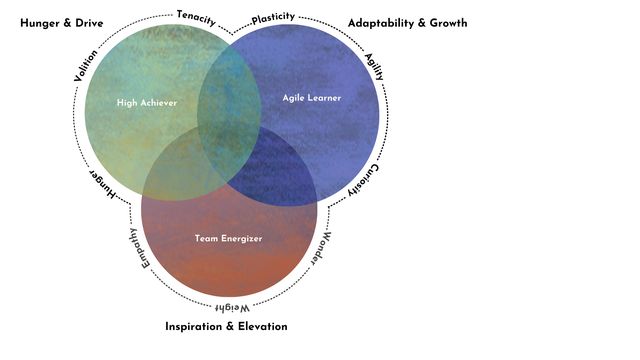
“Greatness doesn’t live in the rock stars. It lives in the alchemy of everything in between.”
“Laura was relevant, inspiring, and thought-provoking — attendees walked away with wisdom to become stronger, more successful leaders.”
Jody Blencowe
Sr. Director, Courtyard Global Brand Management, Marriott International
Key Findings
What the data says about being seen.
Alongside the qualitative research sits a decade of quantitative data: nearly 10,000 responses from 113 countries, every possible demographic, every possible industry. Three findings stand out.
Potential walks when it isn’t seen
People who score high in volition, plasticity, and wonder — but feel they have little chance to show it — are the most likely to disengage and leave. Not for lack of talent. For lack of being seen.
Even good leaders lose them
Among people who report to a leader they respect, those who don’t feel truly seen are just as likely to leave as people who work for a bad one.
Two biases keep us blind
The fundamental attribution error lets us credit our wins to brilliance and our misses to the hire. Functional fixedness makes us see people forever the way we saw them first. (Joshua Bell once played a $3.5M Stradivarius in a subway and earned $32 — same musician, different expectations.)
The Practice
Three shifts to start spotting it.
Change your lens
Evaluate people by where they could go, not only where they’ve been.
Change their story
Help them rewrite who they believe they are — and which strengths they’ve been hiding.
Change the stakes
Give real stretch: assignments, decisions, and roles that let them rise.
Greatness isn’t something you hire. It’s something you hone.
Resources
Get better at spotting potential
The Assessment
A practical tool to help leaders evaluate potential — not just performance — across their team.
The Limitless Leader Report
The talent data behind retention and engagement — why your best people stay, and why they leave.
Solutions
Put the research to work
Three ways to bring this work into your organization:
The Book
Greatness
The book on spotting and stoking the potential already on your team — coming soon.
The Keynote
Igniting Greatness
“How to Build the Team You Need from the Team You Have” — a research-backed keynote on seeing and stoking hidden potential.
Advisory
Executive Coaching
Build the muscle of spotting and stoking potential across your leadership team.
“A year-plus later, we are still talking about the lessons she taught us with candor, heart, grit, and guidance.”
Roy Sexton
Director of Marketing, Clark Hill

About
Meet Laura Gassner Otting
Laura Gassner Otting is a Wall Street Journal and Washington Post bestselling author, researcher, and keynote speaker who helps individuals, leaders, and organizations become limitless. A former White House appointee who helped build AmeriCorps, she spent two decades leading executive searches before turning to the research behind engagement, ambition, and potential.
Her TEDx talk has been viewed millions of times, and her work has been featured by Good Morning America, the TODAY show, Harvard Business Review, Forbes, and more.